


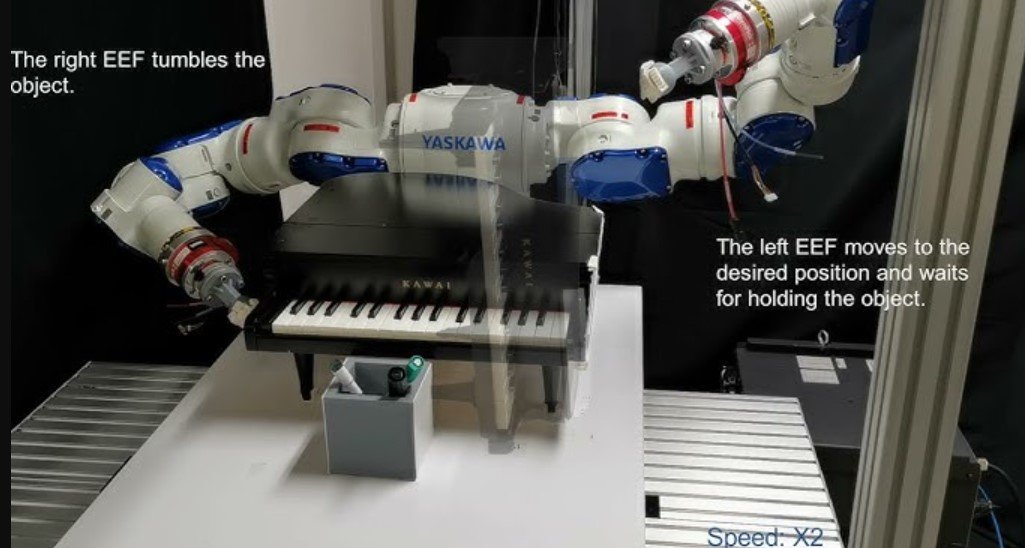
Robots interacting with the physical world face a challenge that humans solve instinctively every day: picking up and holding objects reliably. A coffee cup, a wrench, or a soft package all require different forces, contact points, and motions. Grasping and manipulation planning addresses this challenge by enabling robotic systems to calculate where to place their grippers and how much force to apply so objects remain stable during movement. These algorithms sit at the intersection of perception, physics, and control, forming a core capability for modern robotics used in manufacturing, healthcare, logistics, and service applications.
Understanding the Problem of Robotic Grasping
Grasping is not just about closing a robotic hand around an object. It involves determining contact points, friction conditions, object geometry, and the robot’s own kinematic limits. An effective grasp must resist external disturbances such as gravity, vibration, or motion without damaging the object.
Robotic systems rely on sensor data, such as vision and tactile feedback, to estimate object shape and orientation. From this information, algorithms generate candidate grasps and evaluate their stability. This process must be fast and reliable, especially in dynamic environments where objects may be moving or partially occluded. Learners exploring robotics fundamentals through an ai course in chennai often encounter grasp planning as a practical example of how artificial intelligence meets real-world physics.
Core Algorithms Behind Grasp Planning
Several algorithmic approaches are used to compute stable grasps. Analytical methods model the physics of contact forces and friction cones to determine whether a grasp can resist forces from all directions. These methods are precise but can be computationally intensive and sensitive to modelling errors.
Sampling-based methods generate many possible grasp configurations and evaluate them using stability metrics. While less exact, they are more flexible and can handle complex object shapes. More recently, data-driven approaches using machine learning have gained popularity. These models learn grasp strategies from large datasets of successful and failed attempts, enabling robots to generalise across object categories.
Each approach has trade-offs between accuracy, speed, and robustness. In practice, hybrid systems combine physics-based reasoning with learned models to balance reliability and adaptability.
Manipulation Planning Beyond the Initial Grasp
Once an object is grasped, manipulation planning determines how the robot should move it. This includes path planning, force adjustment, and re-grasping if necessary. For example, rotating an object may require changing contact points or redistributing forces to maintain stability.
Manipulation planning algorithms account for the interaction between the robot, the object, and the environment. They must ensure that motions avoid collisions and respect joint limits while maintaining control of the object. This is especially important in tasks like assembly, where precision is critical.
Advanced planners integrate real-time feedback, allowing robots to adjust their grip if slippage is detected. This closed-loop control improves robustness and enables robots to handle uncertainty in object properties or environmental conditions.
Role of Sensors and Feedback in Robust Handling
Sensors play a vital role in making grasping and manipulation reliable. Vision systems provide information about object pose and shape, while force and torque sensors measure interaction forces. Tactile sensors embedded in grippers can detect contact distribution and slippage.
Algorithms fuse this sensor data to refine grasp strategies continuously. For instance, if an object begins to slip, the system can increase grip force or adjust finger positions. This feedback-driven adaptation brings robotic manipulation closer to human-like dexterity.
Understanding sensor integration is essential for deploying robots in unstructured environments. Training programmes such as an ai course in chennai often highlight sensor fusion as a key skill for building intelligent robotic systems.
Applications and Practical Challenges
Grasping and manipulation planning algorithms are widely used in industrial automation, where robots handle parts at high speed and precision. In logistics, they enable robotic picking systems to sort a wide range of items. In healthcare, surgical and assistive robots rely on delicate manipulation to interact safely with patients.
Despite progress, challenges remain. Objects with deformable or reflective surfaces are difficult to model accurately. Real-world environments introduce uncertainty that is hard to capture in simulations. Researchers continue to improve generalisation, robustness, and learning efficiency to address these issues.
Conclusion
Grasping and manipulation planning form the backbone of physical interaction in robotics. By combining physics-based models, intelligent algorithms, and sensor feedback, robotic systems can compute optimal forces and positions to reliably manipulate objects. As robots move beyond controlled factory settings into everyday environments, these capabilities become even more critical. Continued advances in algorithms and learning methods will push robotic manipulation closer to human-level adaptability, unlocking new possibilities across industries and applications.
Business Name: ExcelR – Data Science, Data Analyst Course Training
Address: 1st Floor, East Court Phoenix Market City, F-02, Clover Park, Viman Nagar, Pune, Maharashtra 411014
Phone Number: 096997 53213
Email Id: enquiry@excelr.com
